If you spotted it and thought What does IDTS mean in text? — you’re in the right place.
This guide breaks it all down. You’ll learn:
- The exact meaning of IDTS
- Why people use it
- When IDTS can sound rude
- How punctuation and emojis change the tone
- Better alternatives when you need to disagree politely
- Simple messaging templates to avoid misunderstandings
By the end, you’ll know how to text like a pro without accidentally hurting someone’s feelings.
Let’s dive in 👇
What Does IDTS Mean in Text?
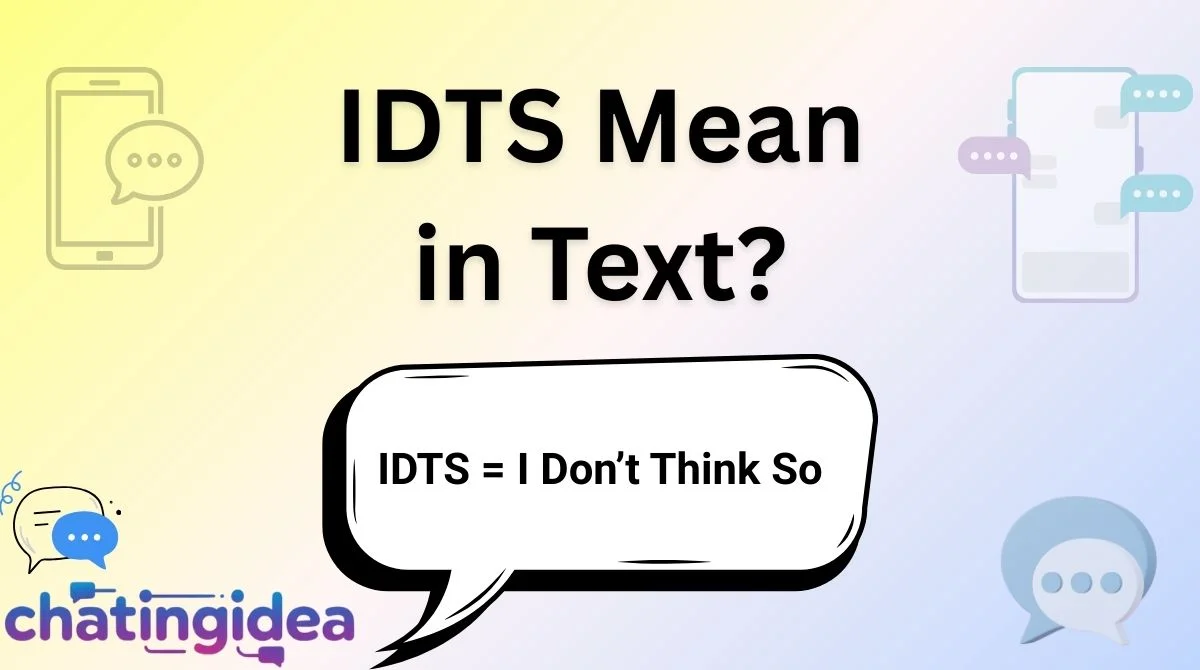
IDTS = I Don’t Think So
It’s a quick abbreviation used in casual texting to express disagreement, doubt or rejection. You’ll see it in:
- Text messages
- DMs on Instagram, Snapchat or TikTok
- Discord chats
- Online gaming
- Group conversations
It saves time. Instead of typing a full sentence, someone can send a single acronym and get the message across.
But here’s the catch…
IDTS can feel blunt if the other person doesn’t expect a short reply.
Example:
“Do you think we’ll finish by tonight?”
“IDTS.”
That feels like a door slam instead of a conversation. Tone matters more than many people realize.
How IDTS Is Used in Messages (With Examples)
IDTS can take on different meanings depending on the situation. Here are three common contexts:
Polite disagreement
“Is that how you pronounce it?”
“IDTS but I might be wrong.”
Doubt or uncertainty
“He said he’ll arrive at 6.”
“IDTS, he’s always late.”
Playful sarcasm 😏
“I’m definitely becoming famous tomorrow.”
“IDTS 😂”
See how punctuation changes everything? A period makes it sharp. An emoji makes it friendly.
Is IDTS Rude or Too Casual?
It can be. Especially when:
- You barely know the person
- The topic is emotional or sensitive
- It’s a serious discussion
- The person expects a supportive reply
Blunt disagreement puts friction in a conversation.
How IDTS can sound:
| Tone | Example | How it may be received |
|---|---|---|
| Polite | “IDTS 🤔” | Curious, open-minded |
| Neutral | “IDTS” | Short, uninterested |
| Harsh | “IDTS.” | Cold, dismissive |
| Playful | “IDTS lol” | Light and humorous |
If you’re unsure how it will land, choose a softer alternative.
When You Should Avoid Using IDTS
Hold back on IDTS when someone:
- Shares personal feelings “I’m upset. I think my friend hates me.”
A cold disagreement here feels cruel. - Tells you serious news “I think Mom needs to see a doctor.”
This isn’t the time for slang. - Is older or in a higher authority role
Teachers, bosses, coworkers — keep it professional. - Needs reassurance
Doubt will make them feel worse.
Rule of thumb:
If someone needs empathy instead of logic, skip IDTS.
Variations and Similar Slang Terms
People love shortcuts. Here are related abbreviations you’ll see:
| Acronym | Meaning | Tone |
|---|---|---|
| IDK | I Don’t Know | Neutral |
| IDC | I Don’t Care | Rude if misused |
| IMHO | In My Humble Opinion | Softer disagreement |
| IMO | In My Opinion | Slightly casual |
| TBH | To Be Honest | Honest but can sting |
Notice something?
Not all slang softens your message. Some can make it worse.
20 Better Ways to Say “IDTS” (Organized by Tone)
Sometimes the truth matters as much as the delivery. These alternatives help you disagree without sounding like a villain.
Polite disagreement options
- I’m not sure about that.
- That doesn’t sound right to me.
- I don’t think that’s accurate.
- I’d have to disagree with that.
- I see it differently.
These sound thoughtful and respectful.
Gentle uncertainty responses
- I could be wrong but…
- I have my doubts.
- Maybe not.
- That seems unlikely.
- I’m not entirely convinced.
Perfect for when you want to keep the conversation open.
Fun and casual alternatives
- Nah don’t think so 😅
- Doubt it 😂
- Not sure about that one lol
- Probably not
- Doesn’t look like it
Lighthearted humor keeps things chill.
Soft disagreement for sensitive topics
- I’m leaning a different way.
- I don’t believe that’s the case.
- Not sure that holds up.
- I’d need more info.
- I’m not on the same page.
Supportive yet honest.
Tone Matters: How To Disagree Without Sounding Harsh
Disagreement doesn’t have to mean conflict. Good communication builds trust.
Here’s a quick cheat-sheet to stay polite:
✔ Add emojis 🙂😅
✔ Add context
✔ Ask questions
✔ Show openness
Example rewrite:
❌ Harsh: “IDTS.”
✅ Better: “IDTS but I’m open to what you found 👀”
The goal isn’t winning
It’s keeping the conversation alive.
Avoid These Communication Mistakes
Even good words get twisted if delivered badly.
Common mistakes with IDTS:
- Using it as a quick shutdown
- Replying without tone indicators
- Pairing it with rude emojis 🙄😑
- Correcting someone publicly in a group chat
- Using it when someone needs emotional support
A simple extra sentence can protect feelings:
“IDTS but let’s check one more source together.”
Friendly > Right.
What Makes a Good Alternative to IDTS?
Use this checklist before hitting send ✅
A good disagreement phrase should be:
- Clear and easy to understand
- Respectful of the other person’s perspective
- Appropriate for the relationship
- Matched to the tone of the topic
- Free of sarcasm (unless joking!)
You’re not a robot.
Words are your social currency — spend them wisely.
Quick Reference Guide: Polite Disagreement Examples
Here’s a simple table you can screenshot:
| Situation | Better Phrase |
|---|---|
| You doubt a fact | “I’m not convinced that’s correct.” |
| You disagree with an opinion | “Interesting but I see it differently.” |
| Topic is serious | “I’d need more details before I can say.” |
| Close friend joking | “IDTS lol, you wild.” |
| New coworker | “I’m leaning toward another interpretation.” |
Good texting etiquette keeps relationships healthier.
Real-Life Example Conversations
A little context goes a long way. Compare:
Scenario: Correcting a friend
Friend: “I think that’s the capital of Australia.”
Version A: “IDTS.” → Annoying
Version B: “IDTS but I always mix those up too 😅” → Polite
Scenario: Responding to emotional worry
Friend: “I think everyone hates me.”
Version A: “IDTS.” → Cold
Version B: “I don’t think so. You’re super loved ❤️” → Supportive
Notice how acknowledgment softens the truth.
Messaging Psychology: Why Short Replies Feel Harsher
Humans look for connection. When text lacks tone, the brain fills the gap with the worst assumption.
IDTS can seem:
- Dismissive
- Judgmental
- Impatient
Adding warmth transforms communication:
- Emojis 😊❤️
- Appreciation
- Questions to invite more sharing
Even a simple “maybe” changes everything.
FAQs: What Does IDTS Mean in Text?
What does IDTS mean in texting?
It means I Don’t Think So, a short way to express disagreement or doubt.
Is IDTS rude to say?
It can be if there’s no emoji or context. It might sound blunt or cold.
Should I use IDTS in professional messages?
No. Choose full sentences like “I’m not sure that’s correct.”
Does IDTS always mean disagreement?
Not always. Sometimes it just shows uncertainty or playful teasing.
What should I say instead of IDTS?
Try “I could be wrong but…” or “I see it differently” for better clarity and kindness.
Summary: Mastering Polite Disagreement in Text
IDTS is quick and popular. But speed often costs clarity. When in doubt:
- Choose a longer, friendlier phrase
- Add a touch of warmth
- Match the formality to the situation
You communicate your values in every message you send.
A little care goes a long way.
Final Thoughts
The words you choose reflect your personality. Slang like IDTS can work with friends who get your humor.
But if the topic is serious or the relationship is new, thoughtful wording keeps misunderstandings away.
Say what you mean.
But say it kindly 🫶

Aurora Blake – English language researcher and vocabulary specialist passionate about explaining word meanings and full forms in a simple, clear way.