Language evolves every day. You probably see new abbreviations online so often that it feels like a full-time job keeping up.
One slang acronym that sparks a lot of confusion is IMAO. At first glance, you might even mistake it for LMAO.
One extra letter changes everything though. Instead of laughter, IMAO takes you straight into the world of attitude, bold opinions, and playful sarcasm.
You’re about to learn exactly what IMAO means, when to use it, and when to run in the opposite direction. With real examples. With polite alternatives.
With a flowchart to help you choose the right phrase fast. And with a tone guide that saves friendships.
Let’s dive in.
What Does IMAO Mean in Text?
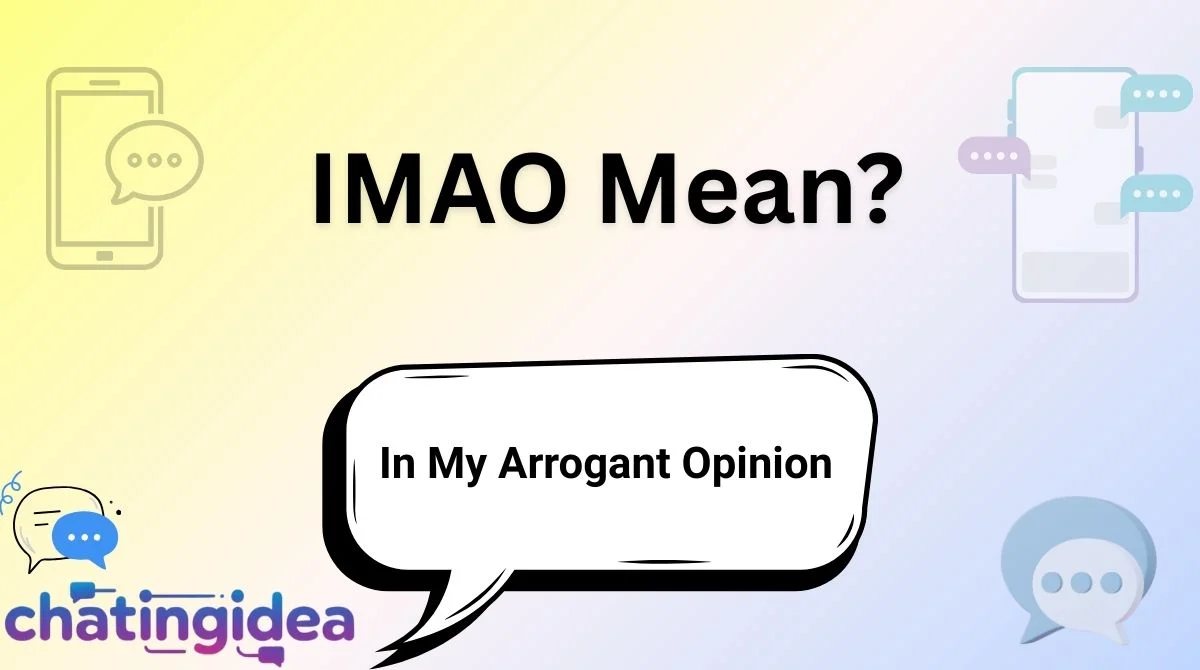
IMAO stands for:
In My Arrogant Opinion
It’s the spicy cousin of “IMO” (In My Opinion) and “IMHO” (In My Humble Opinion). When someone types IMAO, they usually want to:
- Emphasize confidence
- Add humor or exaggeration
- Playfully mock their own boldness
- Sound a little sarcastic
Other versions people sometimes use:
- In My Awesome Opinion (a more playful twist)
- In My Actual Opinion (focused and direct)
In every case, IMAO puts attitude in the message. It doesn’t whisper your views. It shouts them with a smirk.
How Tone Shapes the Meaning of IMAO
Tone drives everything. You can use the same exact phrase and look rude, hilarious, or clever. Context, emojis, and punctuation act like traffic signals.
Here’s how IMAO shifts tone:
| Tone Style | Writing Example | Interpretation |
|---|---|---|
| Friendly, playful | IMAO 😜 that movie was peak cinema | Bold but fun |
| Light sarcasm | IMAO you’re so organized… | Mild roast |
| Aggressive | IMAO you have no clue what you’re doing | Insulting |
| Confident | IMAO this feature will flop | Blunt honesty |
| Trendy/Gen Z style | imao that fit goes hard | Emphasis without being rude |
If the relationship isn’t close enough, someone might read arrogance as disrespect.
Quick rule: If you can’t joke with them in person, don’t IMAO them online.
When You Should and Shouldn’t Use IMAO
✅ Best times to use IMAO
- Close friends who understand your humor
- Online debates about harmless topics
- Meme culture, TikTok captions, funny tweets
- Gaming chats
- Reviews or strong but playful opinions
Example:
“IMAO, that new burger place destroys McD’s.”
Fun. Honest. Bold.
❌ Avoid IMAO in these situations
- Workplace messages or emails
- Talking with someone sensitive about the topic
- Heated arguments
- Serious emotional conversations
- Messaging someone you barely know
Example you should NOT send:
“IMAO your idea makes zero sense.”
That’s how you accidentally start a fight.
IMAO vs IMO vs IMHO: Clear Differences
These slang acronyms live in the same family. But each one carries a unique vibe.
| Acronym | Meaning | Tone Level | Best Use Case |
|---|---|---|---|
| IMO | In My Opinion | Neutral | Safe everywhere |
| IMHO | In My Humble/Honest Opinion | Soft or sarcastic depending on tone | Friendly debates |
| IMAO | In My Arrogant Opinion | Bold, cocky, humorous | Friends, memes |
Shortcut:
The more letters… the more attitude.
Variations and Creative Spins on IMAO
People love remixing slang. Here are versions floating around online:
- IMAO!! — dramatic confidence
- imao — casual lowercase humor
- I.M.A.O. — stylized for emphasis
- IMAO fr fr — bold + serious
- IMAO ong — Gen Z heavy approval
These versions appear often in TikTok comments, meme pages, texting, and gaming chats.
Why Do People Use IMAO?
IMAO solves several communication needs at once:
🗣️ Expression
It highlights strong opinions without sounding too serious.
😂 Entertainment
Adds humor and personality to your messages.
😏 Confidence
Signals, “I know I’m right… and I’m joking, but also not joking.”
😬 Softens the blow
It frames a critique as playful instead of mean.
Online slang performs emotional work. IMAO makes opinions less harsh and more entertaining.
Polite, Casual, and Professional Alternatives to IMAO
Sometimes your message needs the same confidence without the arrogance. Here are better substitutions depending on the situation.
Friendly Texting Options
- Honestly…
- Just saying…
- Tbh (to be honest)
- Low-key / High-key
- I gotta say…
Casual Social Media Alternatives
- Hot take:
- Unpopular opinion but…
- Not gonna lie (NGL)
- I feel like…
Work-Safe Professional Alternatives
- From my perspective
- I suggest…
- Based on the data…
- I recommend…
- It seems more effective to…
Simple trick:
Replace arrogance with clarity.
20+ Ways to Say “IMAO” Without Saying It (With Examples)
Here’s a bigger list with real usage:
| Alternative Phrase | Example |
|---|---|
| Unpopular opinion but… | “Unpopular opinion but pineapple slaps on pizza.” |
| To be fair… | “To be fair this design looks cleaner.” |
| Honestly | “Honestly that’s their best album.” |
| No offense but… | “No offense but cats > dogs.” |
| Just my two cents | “Just my two cents: the app needs dark mode.” |
| I might be wrong but… | “I might be wrong but that’s overpriced.” |
| Hear me out | “Hear me out: chocolate pasta.” |
| Don’t hate me but… | “Don’t hate me but Marvel peaked already.” |
| If you ask me | “If you ask me, this routine isn’t efficient.” |
| Be real | “Be real that haircut suits you better.” |
| Personally | “Personally I’d remove the intro.” |
| Real talk | “Real talk you deserve that promotion.” |
| Not gonna lie | “NGL the movie dragged.” |
| Just saying | “Just saying that’s not a great look.” |
| Truth be told | “Truth be told, I liked the first version more.” |
| Bold take | “Bold take: coffee beats tea every day.” |
| Let’s be honest | “Let’s be honest they carried the team.” |
| Respectfully | “Respectfully your mic sounds terrible.” |
| The way I see it | “The way I see it, we launch sooner.” |
| From my POV | “From my POV, that’s unnecessary.” |
Each one tweaks tone. Some feel softer. Some feel funnier. Pick the one that fits the moment.
How to Choose the Right Expression for Your Message
Here’s a quick flowchart (text version) you can rely on:
Are you talking to close friends?
➜ Yes → Are you joking?
• Yes → Use IMAO or something spicy
• No → Use IMO/IMHO
➜ No → Keep it professional or neutral
(use: “From my perspective” or “Personally”)
Also consider:
- Emojis make tone friendlier 😄
- Periods make tone sharper “IMAO.” feels more rude
- All caps = yelling
- Inside-jokes make IMAO safer
- Relationship history determines risk
Tone travels through tiny details.
Origins and Evolution of IMAO
IMAO didn’t show up yesterday. It grew out of:
- Early internet forum culture
- Chatrooms where people debated everything
- A joking response to IMHO (humble… yeah right)
- Meme communities that love sarcasm
As memes expanded to TikTok, Discord, and gaming culture, IMAO spread like wildfire. Gen Z now uses it not only for arrogance but also for confident excitement.
Shorter. Punchier. More personality. That’s modern communication.
Common Misunderstandings About IMAO
People often confuse it with:
- LMAO — Laughing My A– Off
- IMO — Neutral opinions
- Arrogant insults — Not always the purpose
A misunderstanding can lead to hurt feelings. Someone thinks you mocked them when you meant a playful joke.
Case Study:
Message 1: “IMAO that’s a bad idea”
Received as: “You’re dumb and wrong”
Oops.
Add emotion cues if you want to avoid explosions:
😅 😂 🙃 ✨
Should You Use IMAO in 2025?
Absolutely… if you wield it wisely.
IMAO is trendy, bold, humorous, and extremely common among people:
- Under 35
- Active in meme culture
- On TikTok, Snapchat, Twitter/X, and Discord
However… some still read it as rude.
So think of IMAO like hot sauce:
- A little adds flavor
- Too much ruins the meal
The smartest communicators adjust tone based on the audience.
FAQs About IMAO
What does IMAO mean in slang?
It means In My Arrogant Opinion, usually in a joking or exaggerated way.
Does IMAO always sound rude?
Not always. Close friends may find it funny and bold. Strangers may find it arrogant.
Is IMAO okay to use at work?
No. Use a professional alternative like “From my perspective” or “I recommend”.
Is IMAO the same as LMAO?
No. LMAO expresses laughter. IMAO expresses a confident or sarcastic opinion.
Is IMAO still popular in 2025?
Yes. It’s still widely used across meme culture and casual online conversations.
Conclusion
IMAO gives your opinions personality. It makes conversations lively. It signals humor, confidence, and internet-native energy.
When friends get your joking style, IMAO becomes a fun tool to express yourself boldly.
Yet tone can flip quickly. A playful comment in your head might land like a punch in someone else’s inbox.
So always consider your relationship with the person, your conversation topic, and whether your message needs a little sugar before the spice.
Use IMAO thoughtfully and you’ll unlock a superpower: strong opinions that still feel friendly.

Aurora Blake – English language researcher and vocabulary specialist passionate about explaining word meanings and full forms in a simple, clear way.